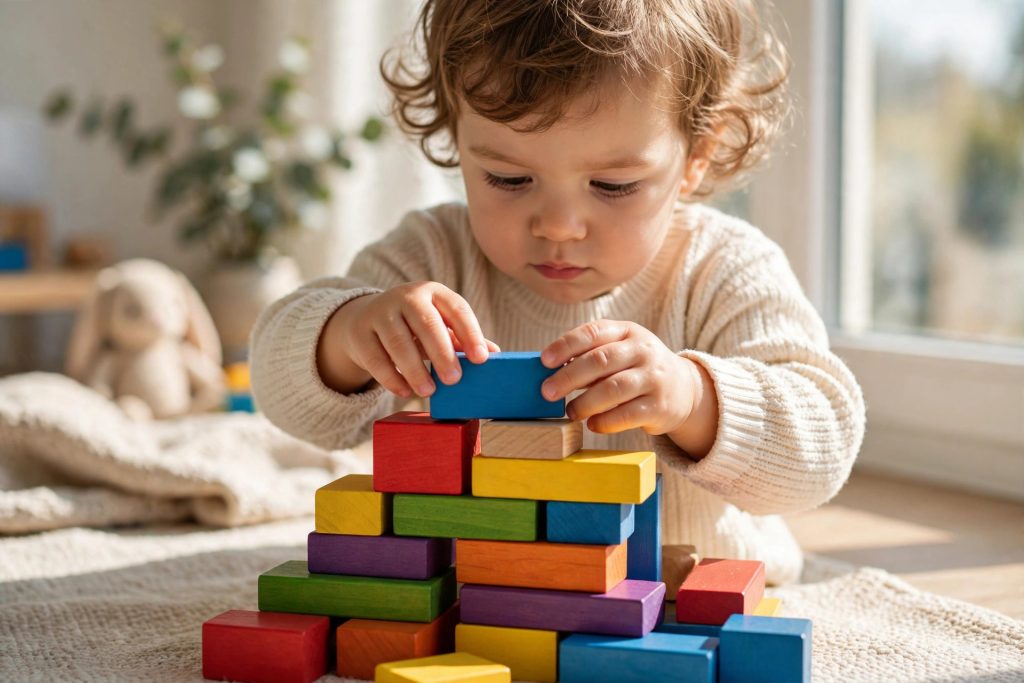
Watch a nine-month-old work on picking up a single puff with thumb and forefinger — tongue out, brow furrowed, total commitment — and you’re watching one of the most important projects of early childhood. Fine motor skills, the small-muscle movements of hands and fingers, underpin everything from self-feeding to writing to buttoning a coat. And the best news: they develop almost entirely through play you don’t have to buy, schedule, or supervise like a coach.
What Fine Motor Skills Are (and How They Unfold)
Gross motor skills are the big movements — rolling, crawling, walking. Fine motor skills are the precise ones: grasping, pinching, stacking, scribbling, turning pages. They develop in a predictable sequence, though — as with all development — the timing varies child to child:
- Raking grasp (4–6 months): Scooping objects with the whole hand, fingers curled like a rake. Everything gets grabbed and immediately mouthed.
- Transferring (6–7 months): Passing objects hand to hand — a bigger deal than it looks, requiring both hands to cooperate.
- Pincer grasp (8–12 months): Thumb and forefinger meet to pick up small things. The neater version (tip to tip) refines over the second year.
- Stacking and nesting (12–18 months): Building towers of two, then four or more blocks — and knocking them down, which is at least half the fun.
- Scribbling and self-feeding (18–24 months): Fist-grip crayons make glorious chaotic art; spoons actually start delivering food to mouths with some reliability.
This progression mirrors what’s happening in the brain: hand control and cognitive planning develop together. When your toddler carefully slots a shape into a sorter, she’s doing spatial reasoning, not just fiddling. Most children move through these stages at their own pace; if progress seems stalled for months or strongly favors one side, it’s worth a calm conversation with your pediatrician — our guide to developmental delays walks through how to raise it. Our motor milestones guide covers the gross-motor side of the same story, and our month-by-month guide shows how fine and gross motor skills interleave across the first year.
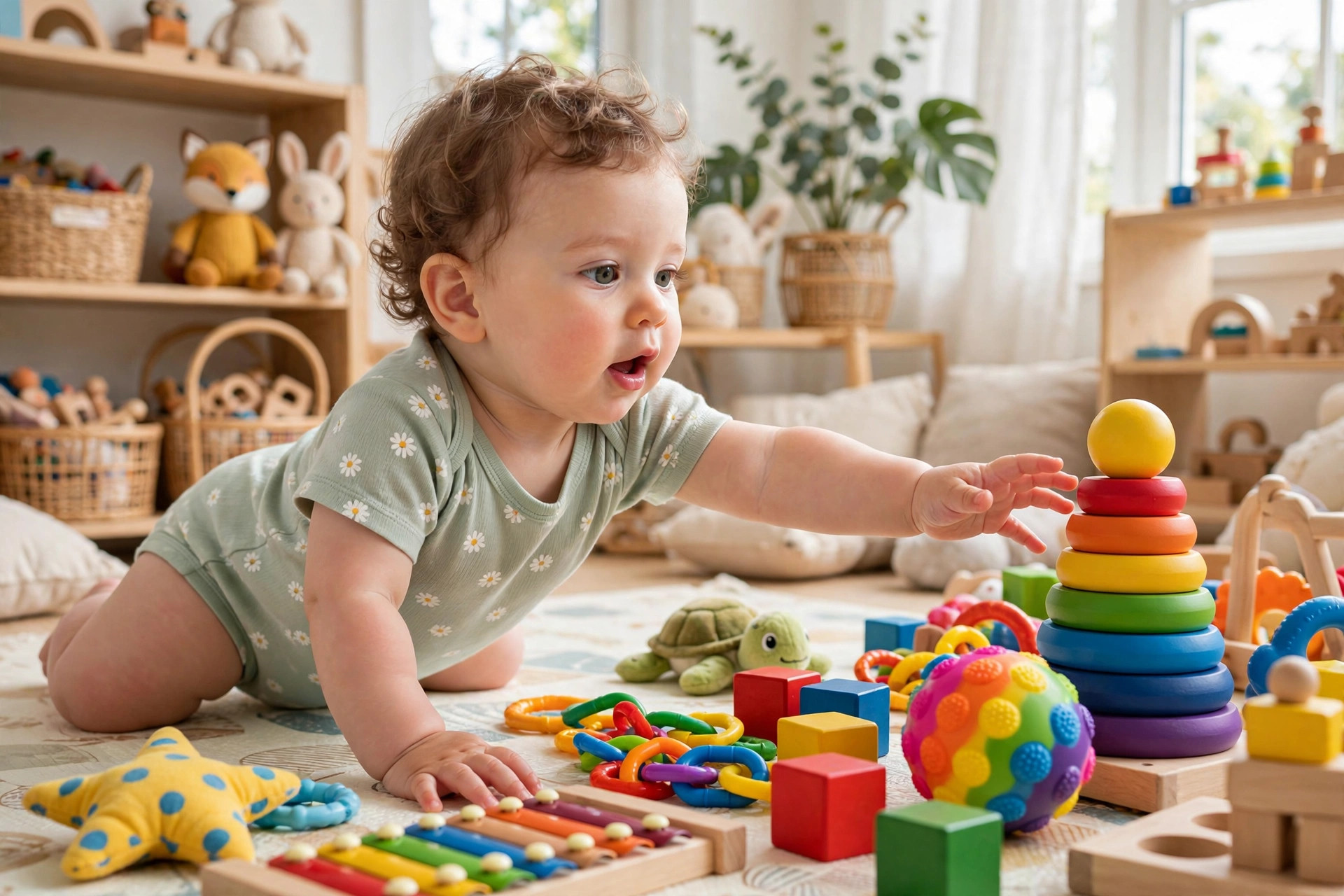
Simple Activities by Age (No Special Equipment Required)
0 to 6 months: Grasp and mouth
Offer safe objects of different textures to grab: a soft cloth, a wooden ring, a silicone teether. Hang a toy just within batting range during tummy time. Let them crinkle paper (supervised) — the sound-and-feel combo is irresistible. Everything at this age is about discovering that hands do things.
6 to 12 months: Pick up and drop
This is the golden age of the pincer grasp. Finger foods (soft, pea-sized pieces) are nature’s fine-motor curriculum — self-feeding practice disguised as lunch. Nesting cups, stacking rings, and containers to fill and dump build precision. Let them turn board book pages (they’ll tear a few; that’s tuition — and our guide to reading with babies has ideas for every stage). Water play with cups and spoons at bath time builds pouring control with zero cleanup stress.
12 to 24 months: Build and create
Large-piece puzzles, chunky crayons and big paper, playdough to squeeze and poke, stickers to peel (peeling is genuinely challenging finger work). “Helping” in the kitchen — stirring, tearing lettuce, dropping pasta into a pot (from a safe distance) — builds real skills with real pride. Simple threading with large wooden beads works wrist control. And the sandbox or a bin of dry rice with scoops? Hours of scooping, pouring, and sifting — every motion a workout for small hands.
Household Items That Double as Fine-Motor Toys
Before buying anything, raid your kitchen and recycling bin. Some of the best fine-motor “toys” cost nothing:
- Muffin tin + pom-poms or balled socks: dropping one item per cup is precise, satisfying work.
- Empty wipe container + scarf: pulling scarves through the slot, then stuffing them back in.
- Laundry basket of socks: matching, balling, and throwing them — sorting practice in disguise.
- Painter’s tape on the floor: peeling strips off is excellent pincer practice (supervise closely).
- Spray bottle with water: “cleaning” windows or the highchair tray builds hand strength fast.
- Cardboard box with holes: pushing pipe cleaners or straws through — endlessly repeatable.
Rotation beats quantity. Put half the toys away for two weeks, then swap. Old toys feel new again, and you’ll spend less while your child plays more deeply. The power of play isn’t in the toy aisle — it’s in the time and attention.

Safety First: Choking Hazards and Supervision
Fine-motor play and small objects go together, which means safety has to go with them. The rule of thumb: anything that fits through a toilet paper tube can block a small airway. Coins, batteries (especially button batteries — a true emergency if swallowed), marbles, pen caps, and older siblings’ small toys are the usual suspects.
A few practical habits:
- Supervise all small-item play — sit with them, don’t just be in the room.
- Check the floor daily if you have older children; their toys migrate.
- Choose age-appropriate art supplies — large, non-toxic crayons and washable paints; skip anything labeled for older kids.
- Store risky items up high — craft supplies, coins, and batteries live out of reach, always.
Letting the Mess Happen
Here’s the uncomfortable truth about fine-motor development: it’s messy. Finger paint ends up on the dog. Rice escapes the bin. The carefully stacked tower gets demolished in half a second. And almost all of that mess is the learning.
Children develop precision by practicing without fear of getting it wrong. A toddler who senses your tension about the mess will play more cautiously — and learn less. So set up for easy cleanup (a shower curtain under the art area, smocks, bath straight after), then genuinely let go. Process over product, every time. The lopsided tower and the brown-purple “masterpiece” are evidence of a brain under enthusiastic construction.
Resist the urge to “fix” their work, too. When you straighten the tower or re-do the puzzle piece, the message received is “you did it wrong.” Instead, narrate what you see: “You stacked three! It’s getting tall!” Descriptive praise builds the intrinsic motivation that keeps them practicing — which is the entire ballgame.
The goal was never a perfect tower or a tidy coloring page. It’s a child who loves using their hands — because that love is what drives the thousands of repetitions that build skill.
Frequently Asked Questions
What are fine motor skills?
Fine motor skills are the small, precise movements of the hands, fingers, and wrists — grasping, pinching, stacking, drawing, buttoning. They develop alongside gross motor skills (rolling, walking) and underpin self-care tasks like feeding and dressing, plus later skills like writing.
What activities develop fine motor skills in babies?
For babies: grasping textured toys, finger foods for pincer practice, stacking cups, turning board book pages, and water play with cups. For toddlers: puzzles, crayons, playdough, stickers, threading large beads, and “helping” with simple kitchen tasks.
When do babies develop the pincer grasp?
Most babies develop the pincer grasp (thumb and forefinger picking up small objects) between 8 and 12 months. It refines over the second year into a neater tip-to-tip grasp. Soft finger foods are one of the best natural ways to practice it.
Are puzzles good for toddlers?
Yes — puzzles build spatial reasoning, patience, and hand precision all at once. Start with simple knob puzzles or 2–4 large pieces around 12–18 months, and increase complexity as your child masters each level. Sitting with them (rather than correcting) keeps it joyful.
Is it normal that everything gets messy?
Completely — and the mess is productive. Children learn precision through uninhibited repetition, so set up for easy cleanup and let them explore freely. A child who’s relaxed about mess practices more, and practice is what builds skill.