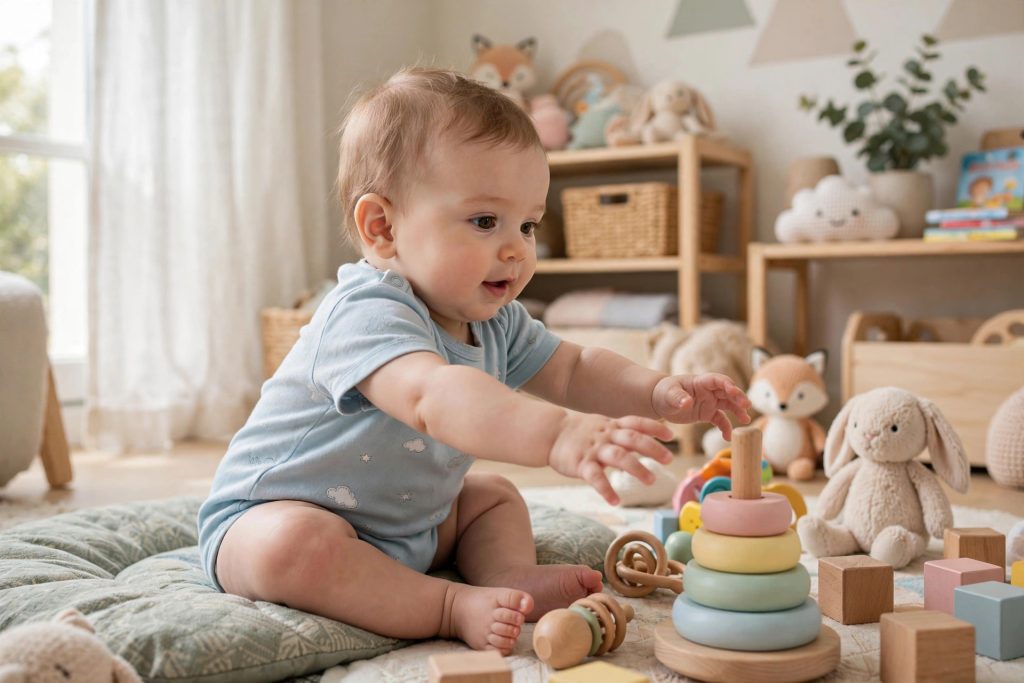
The first time my friend’s daughter rolled over, nobody saw it happen. One minute she was on her back, chewing her fist; the next she was face-down on the rug, looking as surprised as everyone else. Milestones in the first year often arrive like that — quietly, without ceremony, and usually a few weeks after you stopped watching for them.
If you’ve found yourself Googling “should my baby be doing X by now” at midnight, you’re in good company. Nearly every parent does it. This guide walks through the first twelve months, month by month, with the wide normal ranges emphasized — because that’s the part most milestone charts leave out.
What a Milestone Actually Is (and Isn’t)
A milestone is simply a skill most babies develop within a certain window. It’s a signpost, not a deadline. Pediatricians use milestones to get a general picture of development, but they look at patterns across many skills — not whether your baby hit one particular trick on schedule.
Two things worth knowing before we go further. First, the ranges are genuinely wide. The window for walking independently, for example, spans roughly 9 to 18 months. A baby walking at 10 months and a baby walking at 16 months can both be developing perfectly well. Second, babies develop unevenly on purpose. Your daughter might be an early talker and a late crawler; your son might cruise the furniture at eight months and say nothing but “ba” until fifteen months. Skills cluster and leapfrog. That’s normal.
The First Three Months: Waking Up to the World
The newborn weeks are mostly about adjustment — for both of you. But even in those sleepy early days, development is humming along underneath.
0 to 1 month
Your baby’s world is blurry, loud, and brand new. She can see best at about 8 to 12 inches — conveniently, the distance to your face during feeding. She’ll startle at sudden noises, grip your finger with surprising strength, and turn toward familiar voices. Most of her “skills” are reflexes right now: rooting, sucking, grasping, the startle reflex. Those reflexes are the raw material that voluntary movement will later be built from.
1 to 2 months
Around six to eight weeks, many parents get the first real social smile — the one that’s unmistakably for you, not gas. It’s worth the wait. Your baby will start tracking objects with her eyes, making throaty cooing sounds, and holding her head up briefly during tummy time. She may also begin to quiet when she hears your voice, which is the earliest sign that she’s learning you are her safe place.
2 to 3 months
Cooing becomes more musical — little “oohs” and “aahs” that sound almost conversational. Head control improves noticeably; during tummy time she may push up on her forearms and look around like a tiny tourist. Many babies start batting at dangling toys (and missing, adorably). Sleep stretches may lengthen slightly, though “slightly” is doing a lot of work in that sentence.
Months 4 to 6: Rolling, Reaching, and Real Laughter
This is the stretch where many parents feel their baby “wake up” socially. The fog of the fourth trimester lifts, and a distinct little personality starts shining through.
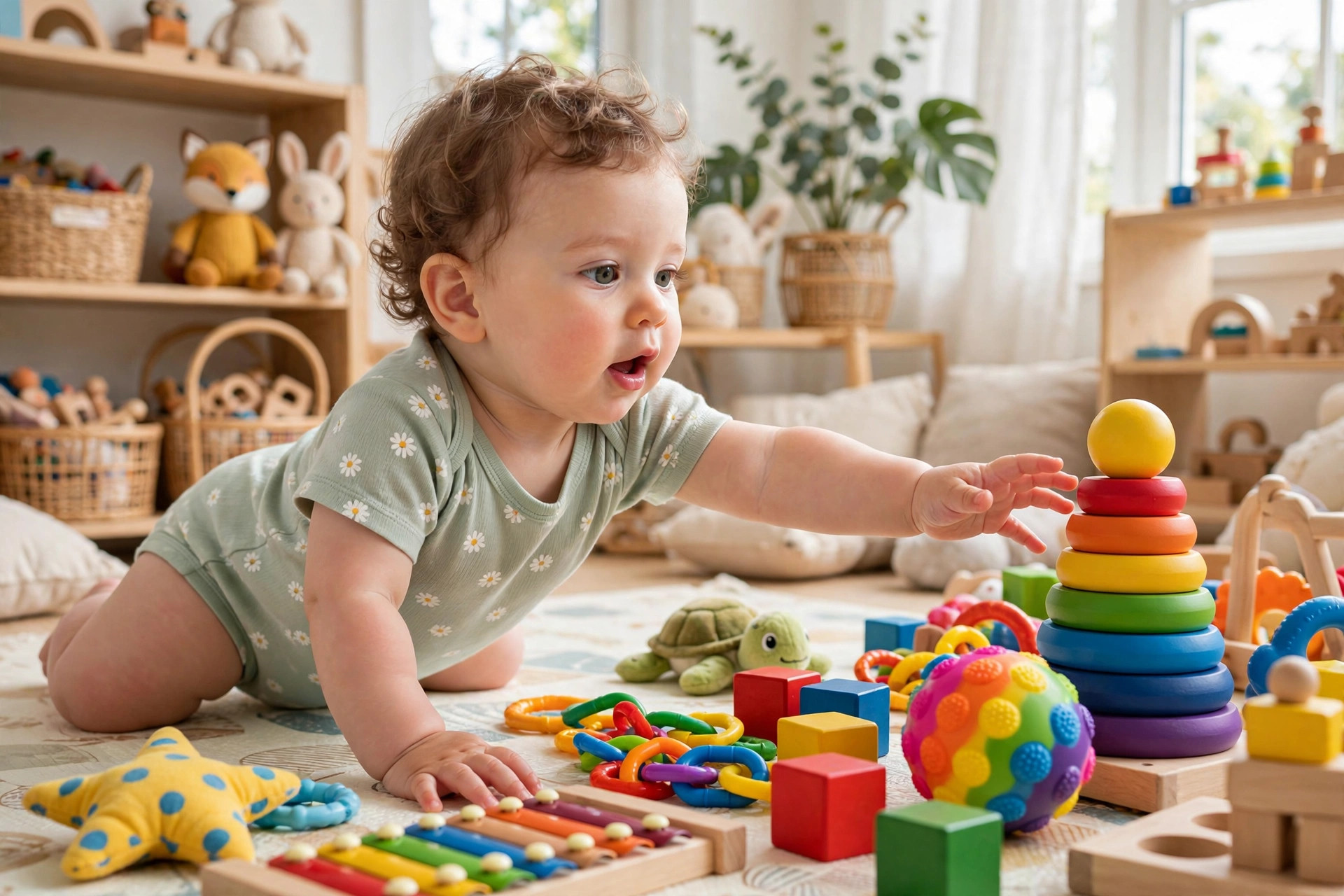
Rolling usually arrives somewhere between 4 and 6 months — typically back-to-front first, since tummy-to-back is easier and often happens accidentally. Reaching becomes deliberate: your baby will grab toys, pass them hand to hand, and immediately put everything in his mouth. Mouthing is how babies learn texture, shape, and “is this food?” (It’s never food. He’ll check anyway.)
That first real belly laugh often lands around 4 months, usually triggered by something ridiculous like Dad sneezing. Babbling expands to consonant sounds — “ba-ba,” “da-da,” “ma-ma” — though these aren’t true words yet, just delicious practice. Many babies sit with support by 6 months, and some manage brief independent sits. If your baby seems fascinated by your food, that’s also around when pediatricians start discussing language milestones and readiness for new experiences — every domain of development starts feeding into the others now.
Months 7 to 9: Sitting, Scooting, and Stranger Wariness
Independent sitting — without toppling like a tiny felled tree — typically firms up between 6 and 8 months. Once sitting is solid, hands are free, and everything changes. Your baby can now hold a toy in each hand and bang them together with the focus of a percussionist.
Locomotion gets creative. Some babies crawl classically at 7 to 9 months; others army-crawl, roll everywhere, or scoot on their bottoms. All of it counts as getting mobile. Object permanence clicks in around 8 months, which is why peekaboo becomes the funniest thing ever invented — and also why separation anxiety often appears. Your baby now understands you still exist when you leave the room, which is both a cognitive leap and, at 2 a.m., a real inconvenience.
Babbling takes on the rhythm of real speech — long strings of syllables with pauses, as if telling you a very important story in a language you don’t speak. Many babies wave bye-bye, clap, and respond to their name. Pincer grasp (thumb and forefinger) starts emerging, which means the era of picking up individual Cheerios with surgical precision has begun.

Months 10 to 12: Pulling Up, Cruising, and First Steps
The final quarter of the first year is all about upright mobility. Most babies pull to stand between 8 and 10 months, then cruise along furniture — that sideways shuffle holding the couch — for weeks or months before letting go. First independent steps land anywhere from 9 to 18 months, with the average hovering around 12 to 14 months.
Fine motor skills sharpen: stacking two blocks, dropping objects into containers (and dumping them out — the dumping is the point), turning board book pages. First true words often appear around 12 months — “mama” and “dada” used specifically, not just babbled. Receptive language far outpaces speech: your one-year-old understands far more than she can say, so keep narrating your day. She also starts following simple instructions (“give me the ball”) and may develop fierce opinions about which cup is acceptable.
Socially, this is the age of imitation. Your baby will “talk” on a toy phone, “stir” in a pot, and attempt to brush your hair with whatever’s handy. Imitation is learning in its purest form — she’s rehearsing for real life.
Supporting Development Without Turning It Into a Job
You don’t need a curriculum. The research-backed “interventions” for the first year are almost comically simple: talk to your baby, read to them, give them safe floor time, and respond when they communicate. That’s genuinely most of it.
A few practical ideas that cost nothing:
- Floor time beats container time. Swings and bouncers have their place, but babies build strength on the floor. A blanket on the living room rug is a complete gym.
- Narrate the ordinary. “I’m warming your milk. Now I’m testing it on my wrist. Here we go.” It feels silly; it works brilliantly for language.
- Follow their lead. If she’s obsessed with a wooden spoon, the wooden spoon is today’s lesson plan. Child-led play builds attention and curiosity better than any flashcard.
- Protect sleep. An overtired baby doesn’t learn well. Healthy sleep habits are developmental rocket fuel, unglamorous as that sounds.
- Let them struggle a little. When your nine-month-old grunts trying to reach a toy, count to ten before rescuing him. Productive struggle builds problem-solving.
Milestones are a map, not a race. Your job isn’t to make your baby hit them faster — it’s to provide the safe, responsive, language-rich environment where they unfold on their own schedule.
When to Mention Something to Your Pediatrician
Most milestone anxiety resolves on its own. But pediatricians genuinely want to hear from you if something feels off — that’s what well visits are for. As a general guide, mention it if your baby isn’t meeting several milestones across an age band, seems to lose a skill they previously had, strongly favors one side of the body, or if your gut says something isn’t right. Parental instinct is data too.
If you’re ever worried about how your baby is progressing, our guide to motor milestones and the signs that merit a conversation with your doctor goes deeper. Early check-ins are always better than late ones — not because something is likely wrong, but because peace of mind is valuable in itself.
This article is for general information and isn’t a substitute for professional medical advice. Your pediatrician knows your baby best.
Frequently Asked Questions
What are the major milestones in the first year?
The big ones parents tend to watch for: social smiling (6–8 weeks), rolling over (4–6 months), sitting independently (6–8 months), crawling (6–10 months), pulling to stand (8–10 months), first words (~12 months), and first steps (9–18 months). Remember each has a wide normal range.
What if my baby seems late on a milestone?
One “late” skill in isolation is rarely concerning — babies develop unevenly. What’s more meaningful is the overall pattern. If several milestones are delayed, a skill disappears, or you’re simply worried, bring it up at your next pediatrician visit. That’s exactly what those appointments are for.
When do babies roll over?
Most babies roll from tummy to back around 4 months and back to tummy around 5–6 months, though the range is wide. Plenty of babies roll one direction weeks before the other. Regular tummy time helps build the neck and shoulder strength rolling requires.
When do babies sit up on their own?
Most babies sit without support between 6 and 8 months. Before that, they’ll tripod (leaning on their hands) and topple sideways — both normal practice. Once sitting is steady, always supervise on elevated surfaces; new sitters have no sense of edges.
Should I compare my baby’s milestones to other babies?
Try not to. Same-age babies can be months apart on individual skills while both developing typically. Comparison is the fastest route to unnecessary worry. Track your own baby’s progress over time instead — steady forward movement is what matters.