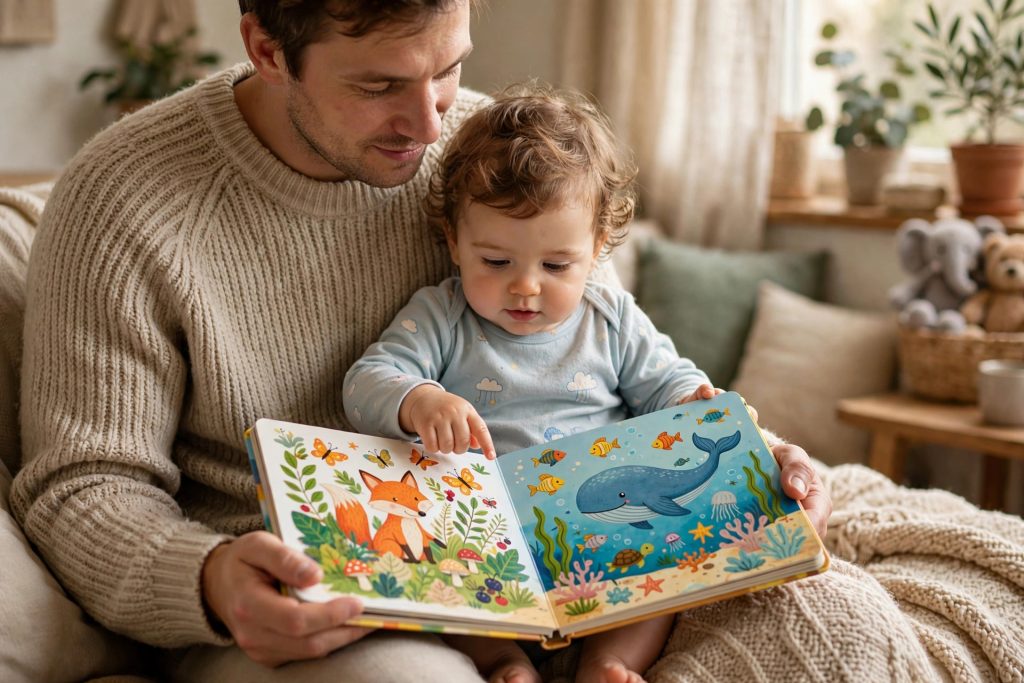
Here’s a secret about reading to babies: it will not look like reading. Your newborn will sleep through it. Your six-month-old will try to eat the book. Your fourteen-month-old will demand the same three pages seventeen times and then wander off mid-sentence. All of this is exactly right. Reading to a baby isn’t a performance — it’s an invitation, extended daily, into the world of language.
The benefits start astonishingly early. Long before babies understand stories, they’re absorbing the rhythm of sentences, the back-and-forth of your voice, and the deep comfort of being held close while words wash over them. Here’s how to make the most of it at every stage — including the wiggly ones.
Why Reading From Day One Matters
Newborns can’t follow a plot, but that’s not the point. In the early months, reading delivers three things: language exposure (the varied vocabulary and sentence patterns of books go far beyond everyday speech), bonding (your voice, your warmth, your undivided attention), and routine (a calming ritual that signals togetherness).
As babies grow, books become one of the richest sources of new words they’ll encounter. The language in even simple picture books is more varied than typical conversation — more rare words, more descriptive phrases, more interesting sentence structures. Children who are read to regularly arrive at toddlerhood with measurably larger vocabularies, and vocabulary is one of the strongest early predictors of later reading success. But the mechanism isn’t mysterious: it’s just thousands of cozy, repeated exposures to words that matter, delivered by someone they love.
What “Reading” Looks Like at Each Age
Adjust your expectations to the stage, and it’ll be fun instead of frustrating:
Newborn to 3 months
Your baby may sleep, stare, or fuss — all fine. Keep it short, keep your voice soft and melodic, and don’t worry about finishing. High-contrast black-and-white books can hold a newborn’s gaze for a few precious minutes. Honestly, at this stage you could read the back of a cereal box in a warm voice and get 90% of the benefit.
4 to 8 months
Everything goes in the mouth, including literature. Board books and cloth books exist precisely for this. Let them chew, pat, and bang the pages — they’re exploring the book as an object, which is a legitimate first step. Point at pictures and name them simply: “Dog! Big brown dog.” They won’t sit still, and that’s developmentally appropriate.
9 to 14 months
Now it gets interactive. Your baby may point at familiar pictures, lift flaps, pat the bunny, and vocalize along. Follow their lead: if they keep flipping back to the page with the truck, read the truck page five times. Repetition is how they learn — the tenth reading of Goodnight Moon is doing more work than the first. (If your baby consistently doesn’t respond to their name or engage with people and books by around 12 months, mention it to your pediatrician — our guide to developmental delays explains how to raise concerns calmly.)
15 months and up
Toddlers develop fierce favorites and strong opinions about how the story goes (do not skip pages; they will prosecute). They’ll start “reading” to themselves, babbling along while turning pages, and naming pictures. Ask simple questions — “Where’s the moon?” — and celebrate every answer. This is also when language milestones and book time start visibly feeding each other.
Choosing Books That Actually Work
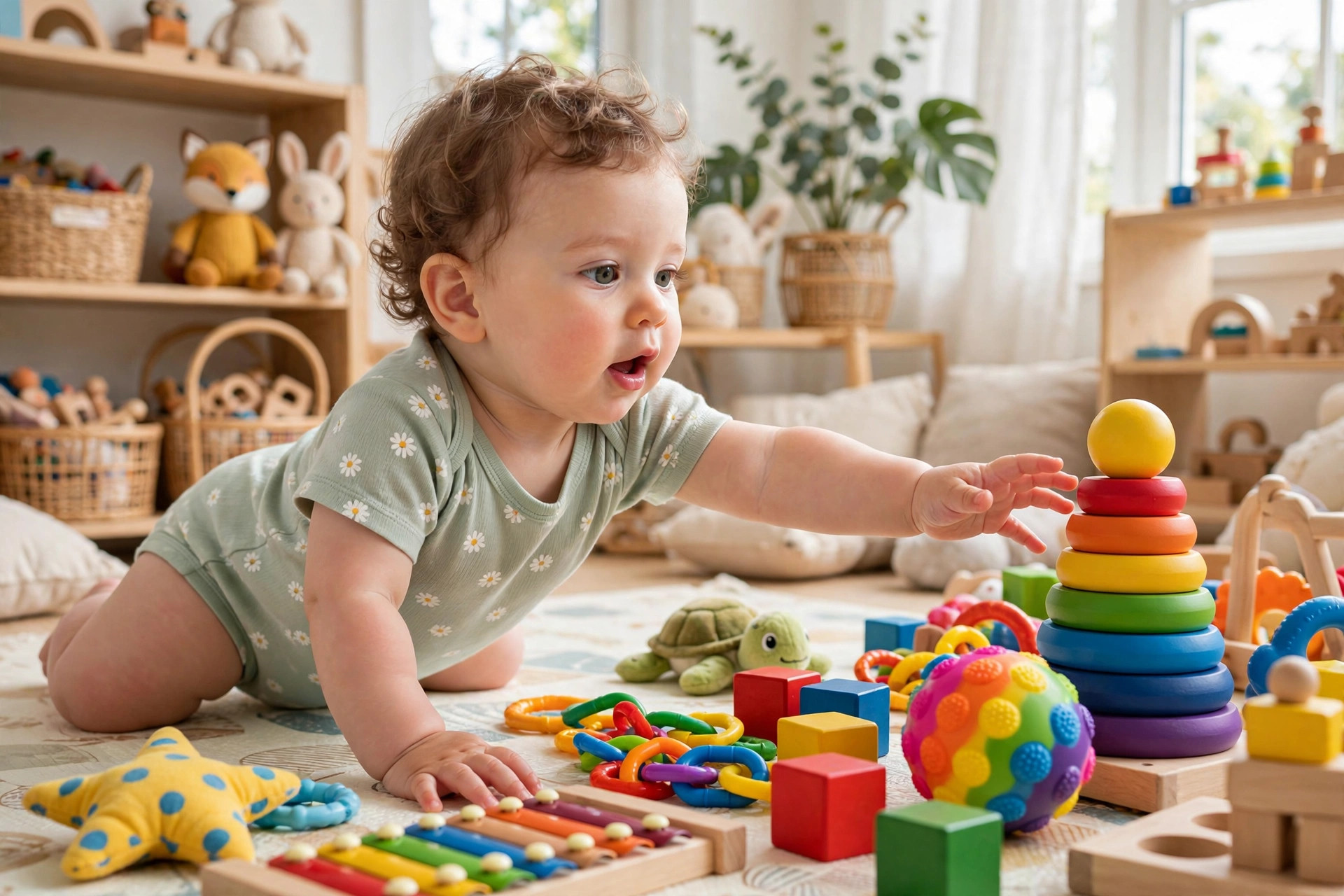
You don’t need a big library. A small rotation of well-chosen books, read repeatedly, beats shelves of untouched titles. Look for:
- Sturdy formats: board books and cloth books for babies; they survive chewing, throwing, and bath-time readings.
- One clear picture per page for the youngest babies — too much visual clutter overwhelms.
- Rhythm and rhyme: nursery rhymes, rhyming stories, and songs-in-book-form are catnip for developing brains. The predictability helps babies anticipate what comes next.
- Real photos or simple illustrations of familiar things — faces, animals, food, vehicles. Babies love looking at other babies most of all.
- Interactive elements: flaps to lift, textures to touch, mirrors to discover. Interaction keeps wiggly readers engaged.
- Stories that reflect your life: books about bedtime, bathtime, and new siblings make the unfamiliar feel manageable.
And don’t overlook your local library — most run free baby story times, which are as much for the parents (solidarity, songs you didn’t know) as for the babies.
How to Read When They Won’t Sit Still
This is the question behind most abandoned reading routines, so let’s settle it: a baby who won’t sit through a book is not rejecting reading. They’re being a baby. Try this instead:
- Read in motion. Read while they toddle around the room, while they’re in the highchair waiting for food, or during the wind-down of a bedtime routine. Captive-audience moments are prime reading real estate.
- Follow, don’t lead. Let them hold the book upside down. Let them turn pages too fast. Your job is to narrate whatever they’re looking at, not to conduct a lesson.
- Go short. One page read with enthusiasm beats a whole book read with gritted teeth. Quit while it’s fun.
- Make it physical. Act out the story — stomp like the elephant, peek like the owl. Toddlers learn with their whole bodies, and playful reading sticks.
- Read the same book again. And again. Familiarity is comforting and deeply educational; each repetition lets them notice something new.
A chewed book is a loved book. If your baby is mouthing the pages, patting the pictures, or demanding the same story for the twentieth time, reading is working exactly as it should.
Making It a Ritual That Sticks
The families who read the most aren’t the most disciplined — they’re the ones who attached reading to something that already happens. Two or three books as part of the bedtime wind-down. One book with morning milk. A basket of board books next to the diaper changing spot for those “please stay still” moments.
Keep books where your child lives, not just on a shelf: a few in the living room, one in the car, one in the diaper bag. Accessibility matters more than organization. And let them see you reading — a newspaper, a novel, a cookbook. Children who grow up around readers absorb the idea that reading is just what people do, which is the most powerful literacy lesson of all. It also dovetails beautifully with your baby’s social and emotional growth — shared reading is shared attention, which is connection in its purest form.
Finally, release the idea of a perfect reading session. The goal was never a silent, attentive audience. The goal is a child who associates books with warmth, closeness, and your voice — thousands of times over. Everything else follows from that.
Frequently Asked Questions
When should I start reading to my baby?
Right away — even newborns benefit from hearing your voice read aloud. In the early months it’s about rhythm, bonding, and language exposure rather than story comprehension. There’s no “too early,” only “haven’t started yet.”
What are the best books for babies?
Sturdy board books with one clear picture per page, high-contrast images for newborns, rhyming and rhythmic texts, and interactive elements like flaps and textures. A small rotation of favorites, read repeatedly, beats a large untouched collection.
How long should I read to my baby each day?
There’s no magic number — even five to ten minutes daily makes a real difference over time. Follow your baby’s cues: short, happy sessions beat long, forced ones. Multiple tiny sessions scattered through the day count fully.
Does reading to babies really help their development?
Yes. Regular reading exposes babies to richer vocabulary than everyday conversation, strengthens the parent-child bond, builds listening skills, and establishes reading as a pleasurable habit. It’s one of the most consistently supported activities in early childhood.
What if my baby just eats the book?
That’s developmentally perfect. Mouthing is how young babies explore objects, books included — which is exactly why board and cloth books exist. Keep offering, keep it light, and the chewing phase will pass. A chewed book is a well-loved book.