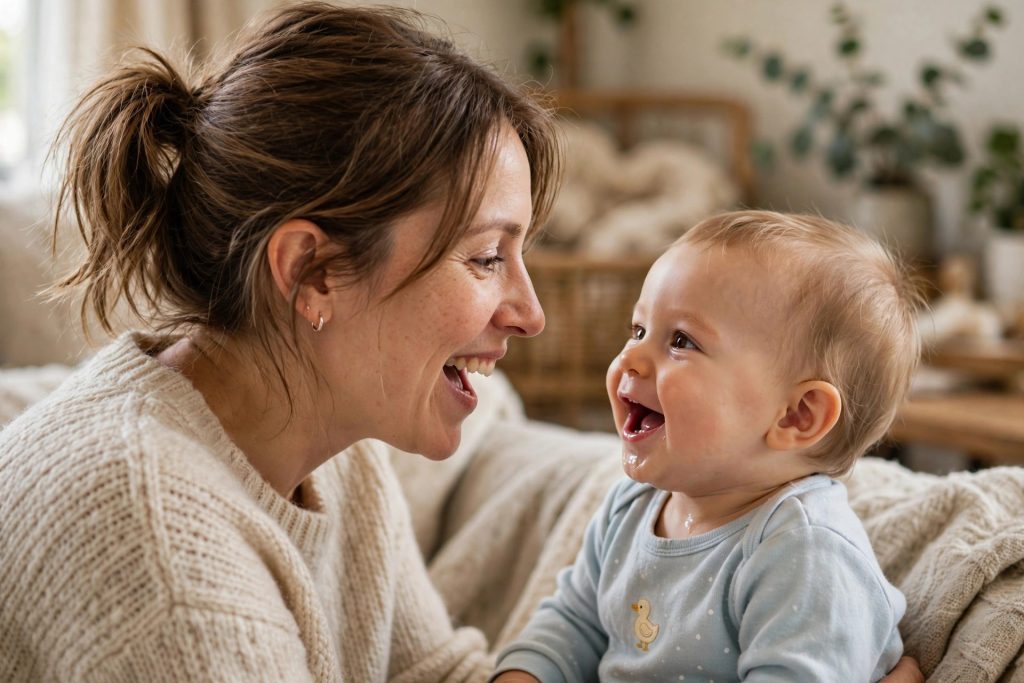
Long before your baby says “mama” and means it, she’s been in conversation with you. The midnight cries, the 6 a.m. coos, the intent stare during feeding — it’s all language under construction. Babies are born communicators; words are just the last piece to arrive.
Parents often ask me when they should expect that first real word. The honest answer: there’s a typical sequence, but the timeline stretches wider than most people expect. Here’s how language unfolds, what you can do to feed it, and when a conversation with your pediatrician makes sense.
The Language Timeline: From First Cries to First Words
Language development starts at birth — not with words, but with listening. Newborns prefer human voices over any other sound and will turn toward a familiar voice within days. Everything that follows builds on that early tuning-in.
0 to 3 months: Cooing and listening
In the early weeks, crying is your baby’s whole vocabulary, and it’s remarkably effective. Around 6 to 8 weeks, throaty cooing sounds appear — those soft “oohs” and “aahs” made in the back of the throat. Your baby is discovering that sounds get responses. When you coo back, you’re teaching the most fundamental language lesson there is: communication is a two-way street.
4 to 6 months: Babbling begins
This is when things get fun. Consonant-vowel combinations — “ba-ba,” “da-da,” “ga-ga” — emerge as your baby plays with the mechanics of sound. At this stage it’s practice, not meaning; she’s learning what her mouth can do. Babies this age also start responding to tone of voice, calming when you speak softly and perking up when you’re animated. They’re reading the music of language before they understand a single lyric.
7 to 12 months: Babbling with intent
Babbling takes on the cadence of real conversation — strings of syllables with pauses, pitch changes, and emphatic endings, as though delivering a tiny TED talk. Around 9 months, many babies understand “no” (and choose to test it immediately). They’ll follow your gaze, point at things they want, and use gestures like waving and reaching to get their message across. Comprehension is racing ahead of speech now, which is exactly as it should be.
12 to 18 months: First words and word bursts
The first true word — used consistently and specifically — typically appears around 12 months. “Mama,” “dada,” “ball,” “dog.” From there, vocabulary grows slowly at first, then often explodes between 18 and 24 months. Two-word combinations (“more milk,” “big truck”) usually follow in the second year. Receptive language stays well ahead: your 15-month-old may only say ten words but understand a hundred.
What “Talking Back” Really Means: Serve and Return
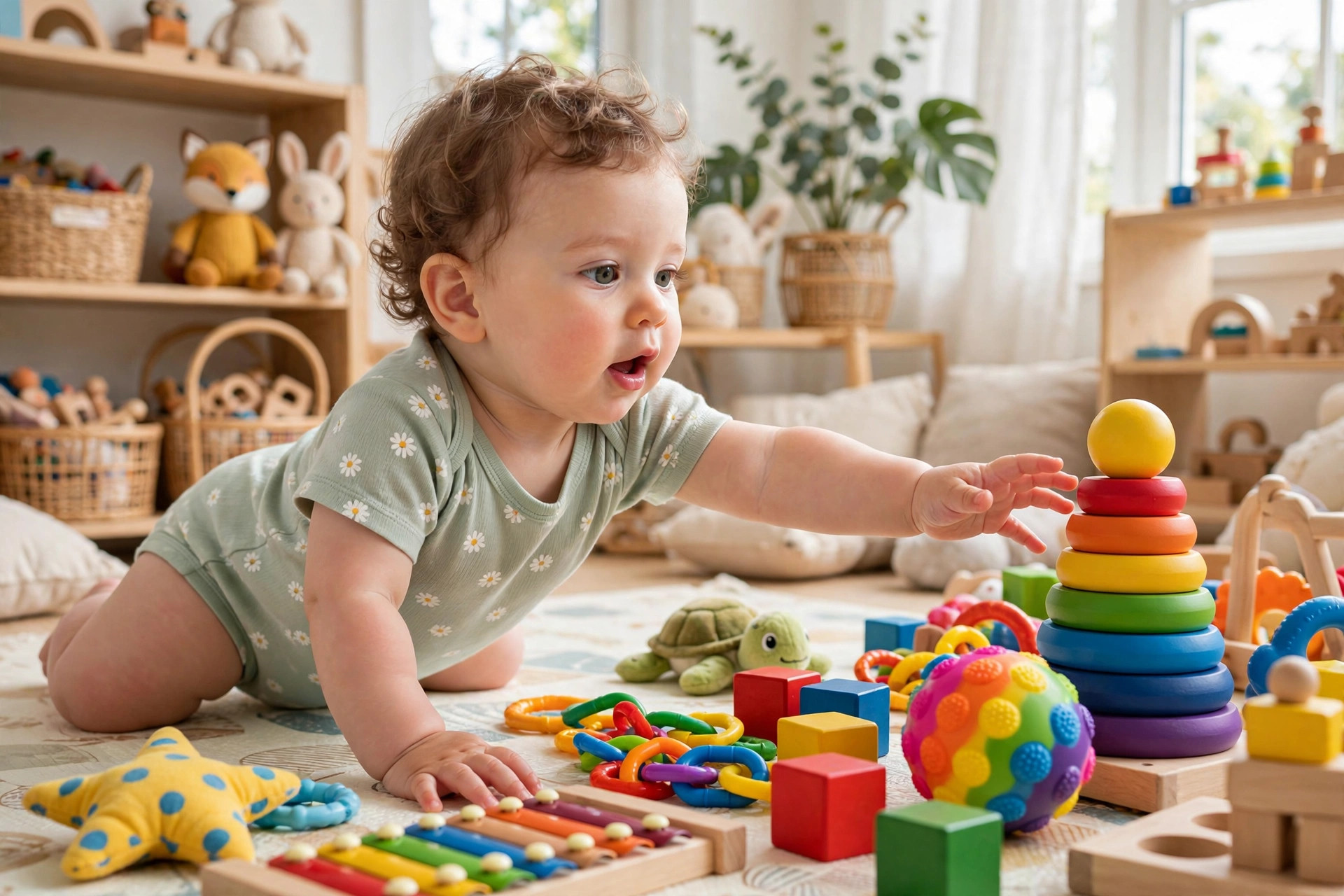
Child development researchers describe early language learning as “serve and return” — your baby serves a coo, a look, or a gesture, and you return it with words, warmth, or attention. Like a game of catch, but with sounds. Every rally wires the brain a little more.
The beautiful part is how ordinary it looks. You don’t need flashcards or educational videos. You need to notice and respond: she babbles, you babble back; he points at the dog, you say “Yes! That’s a big brown dog!” This responsiveness matters more than the number of words you say. A running monologue at a baby who’s staring at the ceiling does less than five minutes of genuine back-and-forth about the spoon she’s chewing.
Screen time can’t do this for you, by the way. Babies learn language from live, responsive humans — the pauses, the eye contact, the way you adjust when they look confused. That’s why pediatric guidance consistently favors real interaction over any app, a point our screen time guide explores in more detail.
Simple Ways to Feed Language Every Day
You already have everything you need. Language nutrition hides inside routines you’re doing anyway:
- Narrate your day. “I’m peeling the banana. It’s yellow and soft. Want to smell it?” Constant, simple commentary gives your baby a running soundtrack of words tied to real things.
- Read, even when they’re wiggly. It doesn’t have to look like story time. Even a few pages of a board book — chewed, patted, and abandoned — count. Our guide to reading to your baby has age-by-age ideas.
- Sing the same songs. Repetition is a feature, not a bug. Nursery rhymes teach rhythm, rhyme, and prediction — and your baby genuinely does not care that you’re off-key.
- Pause and wait. After you ask “Where’s the ball?”, give a full five seconds of expectant silence. That pause is an invitation, and babies often rise to it with a look, a point, or a brand-new sound.
- Follow their focus. If she’s staring at the ceiling fan, talk about the ceiling fan. Language sticks best when it’s about whatever already has their attention — a principle that makes everyday play a language lesson in disguise.
- Get face to face. Babies learn speech partly by watching mouths move. Floor-level, eye-to-eye talking gives them the full show.
The single most powerful thing you can do for your baby’s language is also the simplest: respond to them like a conversation partner, long before they have any words.
Two Languages at Home? That’s a Bonus, Not a Burden
A common worry: will hearing two languages confuse my baby or delay speech? The reassuring consensus is no. Bilingual babies may mix languages in a sentence and may have slightly smaller vocabularies in each individual language at first — but their combined vocabulary is right on track, and they sort the languages out with time.
The practical approach most specialists suggest is consistency: one person, one language, or one language per setting. But honestly, the bigger rule is just to talk — a lot, warmly, in whatever language feels natural. A chatty household in two languages beats a silent one in any single language.
When to Talk to Your Pediatrician
Most language variation is just variation. But do bring it up with your pediatrician if your baby isn’t babbling by around 9 months, doesn’t respond to their name or familiar words by 12 months, has no true words by 15–16 months, or loses words or babbling they previously had. Hearing is worth checking too — even mild, intermittent hearing issues (like fluid in the ears) can quietly slow language down, and they’re very treatable when caught.
Trust your gut here. If family members keep saying “Einstein didn’t talk until he was four,” smile politely — and still mention it at the next checkup. Our overview of baby milestones month by month puts language in the context of everything else developing in year one, and our guide on developmental delays covers how to raise concerns without spiraling.
This article is for general information and isn’t a substitute for professional medical advice.
Frequently Asked Questions
When do babies say their first word?
Most babies say their first true word — used consistently for a specific person or thing — around 12 months, with a normal range stretching from about 10 to 15 months. “Mama” and “dada” babbled at 8 months don’t count yet; “mama” said while reaching specifically for Mum does.
How can I help my baby learn to talk?
Talk with them, not just at them: narrate your day, read daily, sing, get face to face, and — most importantly — pause and respond to their sounds and gestures like a real conversation. Responsiveness matters more than word count.
Is babbling a good sign?
Yes — babbling is exactly what language practice looks like. Canonical babbling (repeated consonant-vowel syllables like “ba-ba-ba”) around 6–9 months is a healthy, expected step. Responding to it enthusiastically encourages more of it.
When should I worry about a speech delay?
Mention it to your pediatrician if there’s no babbling by 9 months, no response to name by 12 months, no true words by 15–16 months, or any loss of previously-used sounds or words. Earlier check-ins are always fine — pediatricians would much rather reassure you than see you worry silently.
Do I need special toys to teach my baby to talk?
No. The “best” language toys are a cardboard box, a wooden spoon, and you. Simple floor play with a responsive adult nearby outperforms any electronic learning toy, because language grows out of interaction, not buttons.