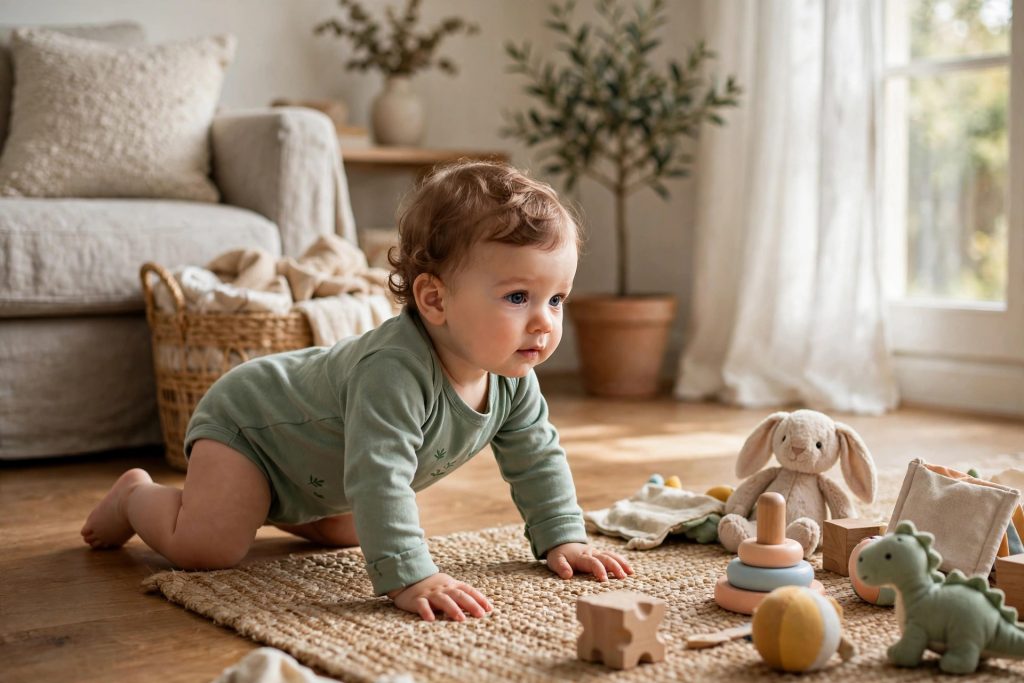
There’s a particular kind of parental pride in watching your baby figure out crawling — and a particular kind of worry when the baby next door is zooming around and yours is still sitting there, perfectly content, going nowhere. If that’s you, here’s the reassuring truth first: the window for crawling is wide, the styles vary wildly, and some babies skip it entirely without any problem at all.
When Do Babies Usually Start Crawling?
Most babies begin crawling between 6 and 10 months, with the average landing around 8 or 9 months. But “crawling” covers a lot of territory. Some babies do the classic hands-and-knees crawl; others army-crawl on their bellies, scoot on their bottoms, roll strategically from room to room, or go straight from sitting to pulling up and cruising furniture. All of these are legitimate ways of getting mobile.
It’s also worth knowing that crawling isn’t considered a mandatory milestone by every pediatric framework — what matters is that your baby is finding some way to move and explore. A baby who never does the classic crawl but cruises the coffee table at nine months is developing just fine. The skill that matters most is the drive to get somewhere, not the specific technique.
The Stages Before the First Real Crawl
Crawling doesn’t appear out of nowhere. Watch closely in the months before and you’ll see the rehearsal:
- Pushing up (3–4 months): During tummy time, your baby pushes up on straight arms, strengthening the shoulders and trunk.
- Rocking (6–8 months): On hands and knees, rocking back and forth like a tiny engine revving. This is practice, not stuckness — though it can look hilariously frustrated.
- Pivoting: Spinning in circles on the belly to reach toys, going nowhere and everywhere.
- Army crawl: Dragging forward on the belly using forearms, legs trailing. Inefficient, effective, adorable.
- Classic crawl: Hands and knees, opposite arm and leg moving together. The cross-pattern movement is great for coordination.
Some babies spend weeks in the rocking phase. Others skip straight from sitting to standing. Both are within the wide range of normal — our month-by-month milestones guide puts the whole first-year sequence in context. And expect new mobility to stir up bigger feelings too — a suddenly mobile baby often gets clingier as their world expands, a completely normal part of social and emotional development.
Setting Up a Crawl-Friendly (and Safe) Space
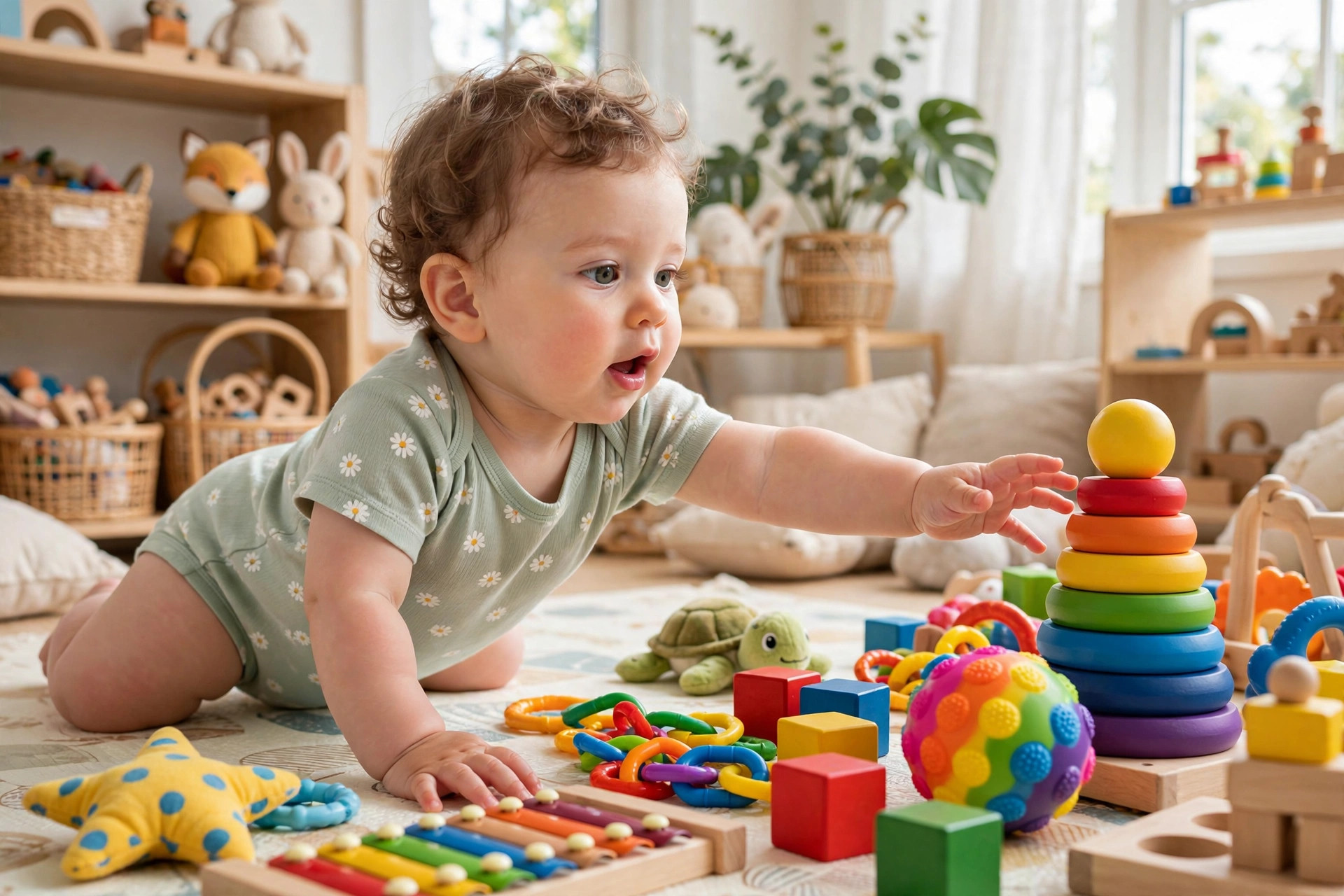
The day your baby becomes mobile is the day your house needs a second look. Crawling-age babyproofing isn’t about perfection — it’s about removing the genuinely dangerous stuff so you can say “yes” more often.
- Get down to their level. Literally lie on the floor and look around. You’ll spot the dangling blind cords, the unsecured bookshelf, the pet food bowl, and the outlet behind the couch you’d never notice from adult height.
- Secure the big things. Anchor bookshelves and TVs to the wall. Babies pull up on everything, and furniture tip-overs are one of the most serious household risks.
- Gate the danger zones. Stairs (top and bottom), kitchens during cooking, bathrooms. A pressure-mounted gate buys enormous peace of mind.
- Manage the small things. Anything that fits through a toilet paper tube is a choking hazard. Do a daily floor scan — coins, batteries, older siblings’ Lego pieces migrate constantly.
- Give them room to roam. Once the space is safe, let them explore it freely. Constant “no, don’t touch” in an unprepared room is exhausting for everyone; a well-set-up room lets curiosity run safely.
Gentle Ways to Encourage Crawling
You can’t (and shouldn’t) force it, but you can make movement irresistible:
- Place toys just out of reach during tummy time — close enough to seem attainable, far enough to require effort.
- Be the destination. Sit a few feet away with open arms and your best excited face. Babies will cross rooms for a parent’s grin.
- Crawl with them. Get on the floor and demonstrate. Babies are born imitators, and a crawling parent is comedy gold.
- Reduce container time. Swings, bouncers, and walkers (which pediatricians recommend skipping entirely) keep babies from practicing. Floor time is where the learning happens.
- Try different textures. A smooth wood floor, a rug, grass outside — varied surfaces invite exploration. Our piece on the power of play has more ideas for making floor time the best part of the day.
Crawling style doesn’t matter nearly as much as crawling spirit. Whether it’s hands-and-knees, army crawl, or a creative scoot, a baby determined to get somewhere is a baby developing well.
What If My Baby Skips Crawling?
Some babies genuinely skip crawling and go straight to pulling up, cruising, and walking. This is well documented and, on its own, not a concern — especially if they’re meeting other motor milestones. The old advice that “babies must crawl for brain development” isn’t supported as a hard rule; plenty of skippers develop perfectly typically.
What is worth paying attention to is overall mobility and symmetry. A baby who finds creative ways to move — rolling, scooting, cruising — is problem-solving with their body. That’s the real milestone underneath the milestone.
When to Mention It to Your Pediatrician
Bring it up at your next visit if your baby isn’t making any attempt to move by around 9–10 months, drags one side of the body noticeably, seems unusually stiff or floppy, or isn’t bearing weight on their legs by late in the first year. Asymmetry — consistently using one side and ignoring the other — is the detail pediatricians most want to hear about, more than the calendar date.
And remember the broader picture: motor development is one thread. If you’re tracking several areas and something feels off, our guide to developmental delays walks through how to raise concerns calmly and what early support looks like. For most families, though, the story ends with a baby who suddenly, triumphantly, crawls straight for the dog’s water bowl.
This article is for general information and isn’t a substitute for professional medical advice.
Frequently Asked Questions
What age do babies start crawling?
Most babies crawl between 6 and 10 months, averaging around 8–9 months. The range is wide, and “crawling” includes army crawling, scooting, and other creative styles — not just the classic hands-and-knees version.
Is it normal if my baby skips crawling?
Yes. Some babies go straight from sitting to pulling up and walking without a classic crawling phase. Skipping crawling alone isn’t a concern as long as your baby is finding other ways to move and meeting other motor milestones.
How can I encourage my baby to crawl?
Plenty of supervised floor time, toys placed just out of reach, and being an exciting destination yourself. Reduce time in swings and bouncers, skip baby walkers, and get on the floor to demonstrate — imitation is a powerful motivator.
Should I worry if my baby isn’t crawling at 10 months?
Not necessarily — especially if they’re mobile in other ways (rolling, scooting, cruising). Mention it to your pediatrician if there’s no attempt to move at all, noticeable one-sidedness, or stiffness/floppiness. Trust your instincts and ask; that’s what checkups are for.
My baby only army crawls. Is that okay?
Completely. The belly-dragging army crawl is a legitimate crawling style that builds plenty of strength. Many army crawlers transition to hands-and-knees crawling later; some go straight to walking. Either path is fine.