I’ve seen the same headlines you have, the ones that splash across social media feeds and news alerts, linking scary words like “carcinogen” with innocent staples of childhood like “breakfast cereal.” It’s enough to make any well-meaning parent’s stomach drop right there in the grocery aisle. If you’ve found yourself mid-aisle, staring at a box of oats you’ve bought a hundred times, suddenly wondering if you should pivot the entire family to an entirely organic diet—or perhaps just hide under a comfortable blanket—you are not alone. This conversation is intensely complicated, often highly politicized, and frequently designed by media algorithms to trigger maximal anxiety. As parents trying to navigate a complex food system, I truly believe it is most helpful for us to deliberately tune out the fear-mongering and focus instead on understanding the agricultural realities and the evolving science that underpins these headlines.
When we approach the table through the lens of fear, the fallout isn’t just about changing what’s on the plate; it quietly shapes a child’s fundamental trust, flexibility, and confidence around eating itself. The resulting stress can be far more palpable at dinner than any residue measured in parts per billion. With all the confusing headlines, conflicting research findings, and deeply polarized content that populates our digital world, it’s remarkably easy to feel overwhelmed. My goal here, coming from my perspective as a pediatric dietitian and researcher, is to pull back the curtain on the hyperbole, cut through the considerable noise, and calmly walk you through what the science actually says about glyphosate’s safety, the nature of the real risks, and how you can take practical, doable steps to reduce your family’s exposure to pesticides without upending your entire life or grocery budget.
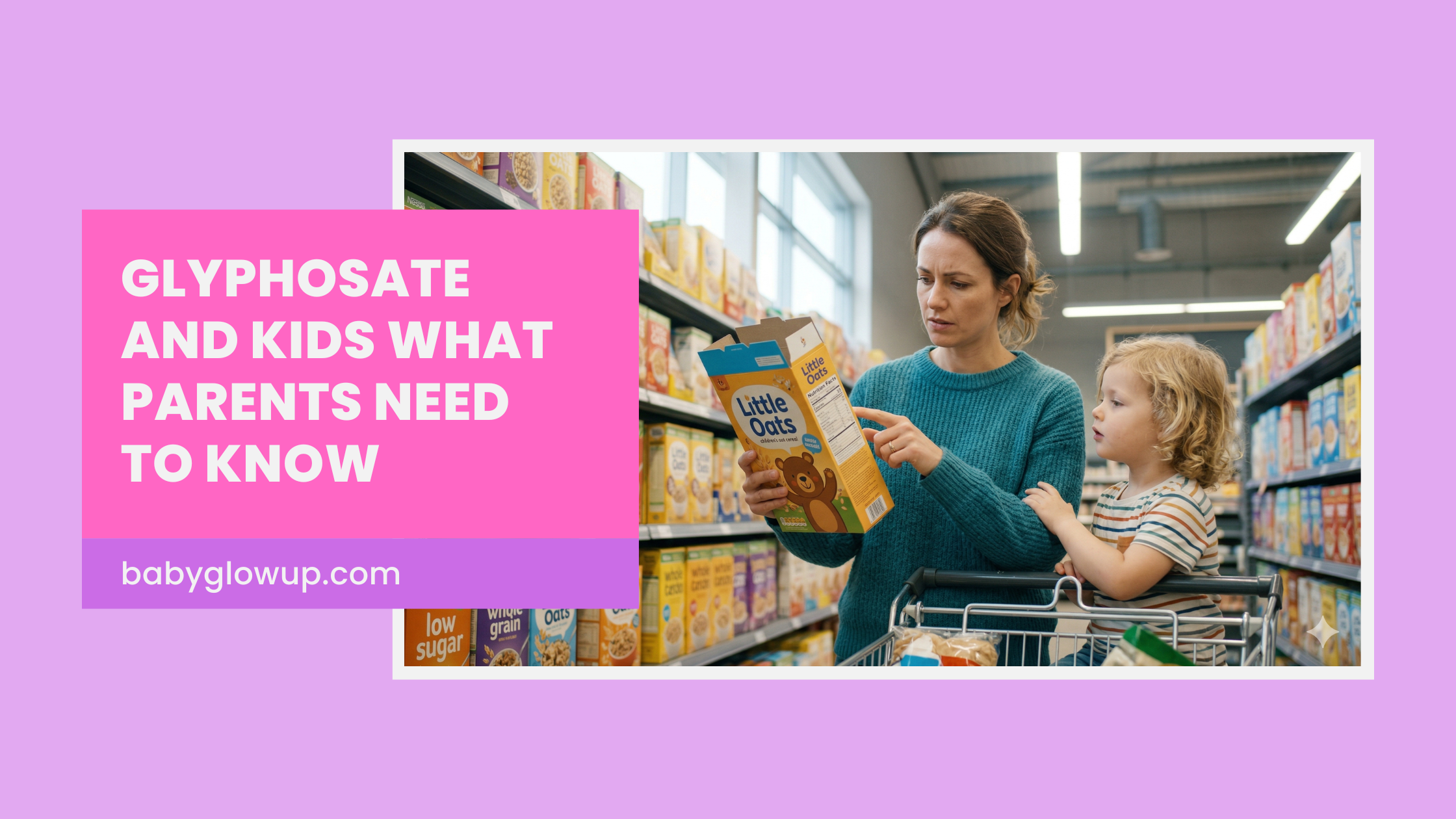
(Image 1: A parent’s contemplation: A mother carefully examines an oat cereal label in a busy supermarket aisle, reflecting the anxiety many parents feel when headlines collide with everyday choices.)
The Pediatric Dietitian’s “Bottom Line” for Parents
If you are reading this while juggling school forms, managing laundry, and planning dinner, and you just want the direct answer before diving into the scientific details, here is the most critical perspective I can offer you as a pediatric health professional. While it is true that the science on glyphosate exposure—especially very long-term, low-level exposure in sensitive populations—is not completely “settled” (which is normal in science), regulatory bodies currently maintain that typical, everyday dietary exposure to glyphosate falls well within established safety limits. This distinction is key: perfect safety is rare, but manageable risk based on current data is standard.
Perhaps more importantly, as a dietitian, I want to emphasize that the overall dietary pattern of your child matters exponentially more than the presence or absence of any single ingredient, chemical residue, or food. A child who consumes a varied diet rich in colorful fruits, vegetables, whole grains, and quality proteins is in a significantly stronger nutritional position than one whose parents have become so paralyzed by pesticide fears that they have significantly narrowed the diet, excluding valuable, nutrient-dense foods (like conventional apples or oats) simply because they aren’t organic. When we let fear dictate the menu, the resulting nutrient gaps can pose a far more immediate and concrete health risk to a developing child than the parts-per-billion residue of an herbicide. We must keep our eye on the big picture of nourishment, not just the details of contamination.
Back to Basics: What Exactly Is Glyphosate?
To understand the controversy, we first need to understand the molecule. Glyphosate is the active ingredient in Roundup, which holds the title of the world’s most widely used herbicide. It was originally discovered by a chemist at Monsanto in the 1970s and was a revolutionary tool for agriculture because it was highly effective against a broad spectrum of weeds. Chemically, glyphosate works by blocking a specific metabolic pathway—called the shikimate pathway—which is essential for the growth of plants and microorganisms. Because humans and other mammals don’t have this specific metabolic pathway, early toxicological assessments concluded it had very low toxicity for people.
Its use, however, truly skyrocketed in the mid-1990s with the introduction of genetically modified organisms (GMOs) known as “Roundup Ready” crops. These crops, which include massive global staples like corn, soybeans, and canola, were genetically engineered to tolerate being sprayed with glyphosate. This meant farmers could spray their entire fields, effectively killing the weeds while the main crop remained unharmed. Today, glyphosate is applied to a vast array of conventionally grown crops, not just GMOs, as a weed management tool during growth. Its presence is ubiquitous; because it is used so widely, its residues are detectable in many common foods, and its runoff can be found in water sources and even in the air near agricultural areas. It has become foundational to modern industrial farming.
Deconstructing the Controversy: Why Are Parents Concerned?
The current landscape of parental anxiety can largely be traced back to a pivotal moment in 2015. That year, the International Agency for Research on Cancer (IARC), which is the specialized cancer agency of the World Health Organization (WHO), published a classification that sent shockwaves through the food world. The IARC placed glyphosate in Group 2A, meaning it is “probably carcinogenic to humans.” This conclusion was based on “limited” evidence of carcinogenicity in humans (primarily from studies linking real-world exposure to non-Hodgkin lymphoma) and “sufficient” evidence from animal studies.
It is worth noting that for context, Group 2A is also where the IARC classifies consuming red meat and working the night shift. However, following that 2015 announcement, two large meta-analyses (studies that combine data from multiple original studies) further confirmed the association between glyphosate exposure and an increased risk of non-Hodgkin lymphoma, particularly in occupational settings like farming. This understandably terrified families. Moreover, concerns go beyond cancer. Emerging, preliminary research has begun asking unsettling questions about other potential health impacts: can it disrupt the endocrine (hormonal) system? Does it negatively impact the composition of the gut microbiome (given that many bacteria do have the shikimate pathway)? Is it a neurotoxin? These areas are still developing, but they fuel the ongoing debate and anxiety.
The Collision of Opinions: Regulatory Agencies (EPA/EU) vs. IARC
This is where the confusion peaks for parents: The IARC (the cancer experts) says “probably carcinogenic,” but regulatory bodies like the U.S. Environmental Protection Agency (EPA) and the European Food Safety Authority (EFSA) explicitly contradict this. The EPA, in its latest major review, maintained that glyphosate is not likely to be carcinogenic to humans when used according to label directions. The EU’s assessment similarly concluded that glyphosate does not pose a carcinogenic hazard. How can brilliant scientists look at the same chemical and come to opposite conclusions?
The answer lies not in a scientific failure, but in the specific mandates and methodologies of the organizations. The important distinction is between hazard and risk.
-
IARC evaluates HAZARD: This assessment asks: Can this substance cause cancer under any possible circumstances, including high, direct exposure? (e.g., Is the lion potentially dangerous?)
-
Regulatory agencies (like EPA) assess RISK: This assessment asks: What is the probability that the substance will cause harm at the realistic, everyday exposure levels experienced by the public? (e.g., What is the risk of being mauled by that lion if it is safely behind a strong cage at the zoo?)
Regulatory bodies focus on dietary exposure data and determine “safe limits,” whereas IARC identifies potential dangers, often based on studies of pesticide applicators or laboratory animals exposed to highly concentrated doses. Both are valuable, but they serve different purposes.
Agricultural Realities: Why Glyphosate dominates Farming
To fully understand why this chemical is on our food, we must acknowledge its powerful utility in the eyes of agriculture. Glyphosate became dominant because it offered farmers a simple, extremely effective, and relatively inexpensive way to manage weeds, which compete with crops for sunlight, water, and nutrients. Without robust weed control, crop yields (the amount of food produced per acre) can drop significantly. Furthermore, controlling weeds efficiently helps reduce crop loss and keeps the cost of producing food stable.
Glyphosate is also a key enabler of conservation tillage (also called no-till farming). In traditional farming, farmers would plow (till) the soil to disrupt weeds before planting. Tilling, however, exposes the soil to wind and water, leading to major erosion and loss of valuable topsoil. By using herbicides like glyphosate, farmers can control weeds without physically disturbing the soil, which helps protect soil structure and sequester carbon. Supporters argue that banishing glyphosate without a comparable replacement would force farmers to return to intensive tilling, or to switch to older, potentially more toxic, alternative herbicides, which would have their own, potentially worse, environmental and health risks. It’s a complex trade-off that agricultural science must grapple with.
Quantifying the Exposure: How Much Glyphosate Is Actually in Food?
Now let’s talk about the actual numbers, because this is where the fear often outpaces the reality. Residues of pesticides in our food system are not measured in percentages, or even parts per million (ppm). They are measured in parts per billion (ppb). To understand how unfathomably small a unit this is, imagine this: one ppb is roughly equivalent to one single drop of water diluted into an entire Olympic-sized swimming pool. It is a vanishingly small quantity. The USDA’s Pesticide Data Program (PDP) conducts rigorous annual testing on thousands of food samples (including produce and commodities) to monitor these levels. While glyphosate is frequently detected due to its massive use, it is almost exclusively found at these minute, parts-per-billion levels.
The Elephant in the Room: Oats, Cereals, and Pre-Harvest Use
We must address why oats and children’s breakfast cereals dominate the headlines and social media flurries. The primary reason is that glyphosate is sometimes used on certain non-GMO crops, especially oats and wheat, just before they are harvested. This is called pre-harvest desiccating. Spraying the mature crop kills the foliage and dries out the entire plant evenly, which allows farmers to harvest more quickly and efficiently, especially in shorter growing seasons. Because the herbicide is applied so close to harvest, the residues on the actual oats can be significantly higher than those found on corn or soy. While the environmental testing by some advocacy groups has found detected levels that look high compared to zero, they still consistently fall well below the legal tolerance limit established by the EPA, which for oats is currently set at 30,000 ppb.
Assessing the Real Risk: Is Glyphosate Safe for Kids?
This is the central question that keeps parents up at night: Is my child actually safe eating these foods? The most accurate, honest, and straightforward answer I can provide is: The science is not fully “settled,” but the vast majority of international regulatory bodies currently conclude that typical dietary exposure levels do not pose a significant risk to human health, including that of children.
The intense concern regarding cancer is derived primarily from assessments of high-dose, direct, occupational exposure in farmworkers—people who are mixing, loading, and spraying the concentrated herbicide day after day, year after year. The average person’s dietary exposure from food residues is exponentially lower. While we desperately need more long-term, specific studies focusing on low-level exposure in children, existing toxicological models suggest a powerful reality: to exceed the established safety threshold (the EPA’s acute or chronic reference dose), a child would need to consume unrealistically, almost absurdly, massive quantities of even the highest-residue foods, every single day, for years. As one safety analyst calculated, to even approach the reference dose, a child would need to eat several dozen servings of high-residue oat cereal, every single day, over the long term.
(Image 2: Action for assurance: Thoroughly washing fresh fruits and vegetables under clear running water is one of the most practical and effective steps any parent can take to significantly reduce surface pesticide residues, empowering you with a simple solution in your own kitchen.)
Navigating the Grocery Store: Organic vs. Conventional Produce
For many parents, the logical next step is to choose organic. It’s the most common and arguably the most powerful strategy available to us to reduce pesticide exposure. By law, USDA Certified Organic crops must be grown without the use of synthetic pesticides or herbicides like glyphosate. The decision to opt for organic oats, breakfast cereals, and high-residue foods (like fruits with edible peels like apples and peaches, and commodities like soy and corn) can absolutely help reduce your child’s exposure to these synthetic chemicals. This is a valid and health-conscious choice.
However, choosing organic is not a magic shield, nor is it a simple “clean vs. dirty” distinction. Organic produce is not pesticide-free. Organic farmers are permitted to use a long list of naturally derived pesticides and copper-based fungicides, some of which carry their own significant toxicological profiles and environmental concerns. The essential takeaway for families with budget or access constraints is this: Eating plenty of conventionally grown fruits and vegetables is demonstrably safe and overwhelmingly beneficial for your child’s health. In fact, research consistently shows that the health benefits derived from the fiber, vitamins, and powerful antioxidants in conventionally grown produce exponentially outweigh any potential theoretical risk from the pesticide residues measured at parts-per-billion levels. Avoiding produce altogether because it isn’t organic is, nutrition-wise, a self-defeating move.
Practical, Evidence-Based Steps to Reduce Your Family’s Exposure
The truly empowering and good news is that there are very practical, evidence-based, and inexpensive steps you can take today, without upending your entire grocery budget or overhauling your life. These are the exact tips I use in my own kitchen as both a pediatric dietitian and a mom:
-
Wash all produce thoroughly. While a simple rinse doesn’t eliminate everything, washing produce vigorously under clear running water (as shown in image 2) can remove a significant portion of surface pesticide residues, as well as dirt and bacteria. Special veggie sprays are not necessary; water and friction work beautifully.
-
Filter your drinking water. Water can be a potential source of glyphosate runoff. A quality water filtration system (even a standard carbon filter pitcher) that is certified to remove herbicides is a simple, set-it-and-forget-it strategy.
-
Vary your child’s diet. This is perhaps the most critical advice I can give. By rotating foods across a wide range of different fruits, vegetables, legumes, whole grains, and other plant foods, you ensure your child gets a broad spectrum of nutrients while naturally limiting their risk of concentrated, repetitive exposure to any single pesticide (since different crops are treated differently).
-
Prioritize organic versions of high-residue foods. If it is within your budget, consider strategically prioritizing organic purchases. Oats are a key one here, given the pre-harvest application. Prioritize fruits and vegetables with thin, edible skins where surface residues are more significant.
Conclusion: Prioritizing Nourishment over Panic
I understand the profound anxiety that comes when you read a frightening headline about pesticides in the food you feed your children. As a mother myself, I can absolutely feel that physical pang of worry too. But what I always come back to, when the noise gets too loud, is the fundamental truth of nourishment: the overall dietary pattern of your child matters exponentially more than the existence of any single food or ingredient.
When we approach the table through the lens of fear, the anxiety it generates can subtly damage our children’s entire relationship with eating, creating lasting inflexibility and stress that can be far more disruptive to their well-being than parts-per-billion residues. The science tells us that while the landscape of risk is complex, the data suggests that standard dietary levels are safe and that the nutritional value of a varied diet is immense.
Let’s take that worry and translate it into simple, actionable steps: Wash the produce. Buy a water filter. Vary the grains. Prioritize organic where you can, but celebrate conventional produce where you must. We can choose nourishment over panic, and confidence over fear. This, fundamentally, is what our children need to know about food.
Frequently Asked Questions (FAQ)
Here are the direct answers to the questions I hear most frequently from parents:
Q: Does glyphosate cause autism?
A: No, there is no credible scientific evidence directly linking dietary glyphosate exposure to the development of autism spectrum disorder (ASD). While some small correlations are actively studied in environmental health research, regulatory bodies and neurological associations do not list glyphosate exposure as a established or likely risk factor for autism.
Q: Is there glyphosate in baby food?
A: Yes, because glyphosate residues are present in the global food supply, testing by consumer advocacy groups has frequently detected vanishingly small, parts-per-billion levels in baby food made from conventional (non-organic) ingredients like oats, rice, and even corn or soy. However, these levels have consistently fallen well within the established legal safety limits.
Q: Are there glyphosate residues in breast milk?
A: While some studies have successfully identified glyphosate residues in breast milk at very low levels (parts-per-billion), it is highly unlikely that these levels pose a significant safety risk to an infant. Scientific and pediatric organizations overwhelmingly maintain that the powerful and irreplaceable developmental benefits of breastfeeding—nutritional, immunological, and emotional—far surpass any theoretical risk from potential chemical residues.
Q: Should I throw out all non-organic oats?
A: No, that is absolutely not necessary. Conventional oats are still a fantastic, nutritious whole grain that provides valuable fiber and vitamins. Finishing the conventional oats you have and focusing on adding variety to your grains is a much more pragmatic (and budget-friendly) strategy than reacting to a headline with a full kitchen purge.
Q: Do pesticides build up in a child’s body?
A: Glyphosate itself is not lipophilic (meaning it is not easily stored in fat), and it does not bioaccumulate (build up significantly) in the human body. Studies indicate that it is rapidly excreted through urine and feces within days of ingestion. The primary focus of concern is therefore not bioaccumulation, but the nature of chronic, low-level exposure on developing systems over long periods of time.