
Your two-year-old just threw their sippy cup across the kitchen because you cut the toast into triangles instead of squares. You feel your jaw tighten. Every parenting instinct you grew up with says this is the moment for a sharp word or a swift consequence — but something in you hesitates. Is there really no better way to handle this?
There is. It’s called positive discipline, and despite the gentle name, it isn’t permissive, soft, or a free pass for bad behavior. It’s a practical, research-informed approach to guiding toddlers that teaches them what to do instead of just punishing what they did wrong. And once you understand how a toddler’s brain actually works, the whole thing starts to make a lot more sense.
What Positive Discipline Actually Means
The word “discipline” comes from the Latin disciplina, meaning teaching or instruction. That’s the entire philosophy in a nutshell: discipline is about teaching, not punishing. Positive discipline aims to build the skills your toddler is missing — impulse control, emotional regulation, problem-solving — rather than making them suffer for not having those skills yet.
This matters because a toddler’s brain is genuinely unfinished. The prefrontal cortex, the part responsible for reasoning, planning, and controlling impulses, won’t be fully developed until the mid-twenties. Your two-year-old isn’t giving you a hard time; they’re having a hard time. They literally cannot do what you’re asking in the way an older child could.
Positive discipline doesn’t mean no boundaries. Quite the opposite — clear, consistent limits are one of its foundations. The difference is how those limits are set and enforced: with calm firmness and connection instead of fear, shame, or pain. A child who feels safe and understood is far more capable of learning than a child who is frightened or humiliated.
Why Punishment Backfires With Toddlers
Traditional punishment — yelling, shaming, spanking, harsh time-outs — can stop a behavior in the moment. That’s why it’s tempting. But with toddlers, the costs quietly pile up.

First, punishment teaches the wrong lesson. When you yell at a toddler for hitting, what they learn isn’t “hitting hurts others.” What they learn is “big people yell when they’re upset” — which is, ironically, a lesson in aggression. Toddlers learn far more from what we model than from what we say.
Second, punishment damages the very relationship you need for cooperation. A toddler who is afraid of you will comply when you’re watching and act out when you’re not. A toddler who trusts you will come to you when they’re struggling — which is exactly what you want.
Third, fear shuts down learning. When a child is flooded with stress hormones, the thinking part of their brain goes offline. They can’t reflect on what happened, understand your point, or plan to do better next time. All the “teaching” you hoped the punishment would deliver simply doesn’t land.
This doesn’t mean you never feel angry or never make mistakes. You will. Positive discipline is a direction, not a perfection standard. What matters is the overall pattern: more teaching, less punishing; more connection, less control.
7 Positive Discipline Tools That Actually Work
Theory is nice, but you need things to do at 7 a.m. when the toast triangles cause a meltdown. Here are the tools that work best with toddlers:
1. Get down to their level and connect first
Before you correct, connect. Crouch down so you’re eye to eye, use their name, and acknowledge what they’re feeling: “You’re really upset about the toast. You wanted squares.” This takes ten seconds and it changes everything. A toddler who feels heard can actually listen. A toddler who feels steamrolled cannot.
2. Offer limited choices instead of commands
Toddlers are desperate for autonomy. Instead of “Put your shoes on now,” try “Do you want the red shoes or the blue shoes?” Both options are acceptable to you, but your child gets to feel in control. Choices work for food, clothes, which book to read, and which order to do the bedtime routine. The trick: only offer choices you’re genuinely fine with.
3. Redirect instead of just saying no
“No!” tells a toddler what to stop but gives them nothing to do instead — and a toddler with no direction will simply find a new way to get into trouble. Pair every “no” with a “yes”: “We don’t throw cups. Cups are for drinking. You can throw this soft ball into the basket.” Redirection works because it respects the underlying impulse (throwing is fun and developmentally normal) while changing the target.
4. Use natural and logical consequences
A natural consequence is what happens on its own: if your toddler refuses their coat, they feel cold (as long as it’s safe to let them). A logical consequence is related, respectful, and reasonable: if they throw food, the meal ends — not as punishment, but because “food is for eating; when we throw it, it tells me you’re done.” Avoid consequences that are unrelated (“no TV because you hit your sister”) — toddlers can’t connect those dots.
5. Create a calm-down space, not a punishment chair
Forget the punitive time-out chair facing the wall. Instead, set up a cozy corner with pillows, a few books, and maybe a stuffed animal — a place your child can go (with you, at first) when big feelings take over. Frame it positively: “Let’s go to the cozy corner until our bodies feel calm.” You’re teaching emotional regulation, not isolation. For more on riding out the storm itself, see our guide to managing toddler tantrums with calm and connection.
6. Prevent problems with routines and transitions
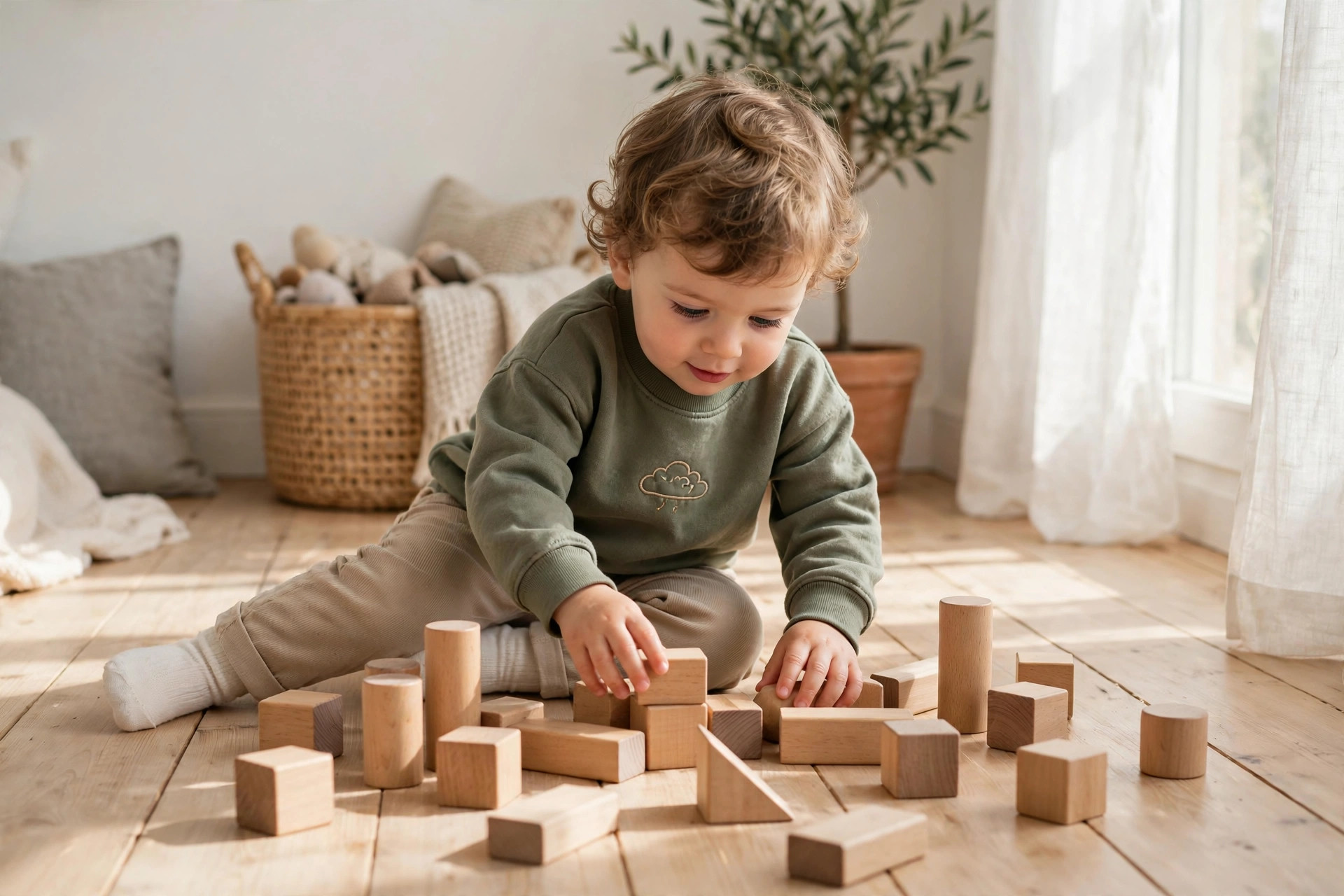
Most toddler misbehavior is preventable. Toddlers fall apart when they’re hungry, tired, rushed, or blindsided by transitions. Predictable routines — especially a solid bedtime routine that actually works — reduce the number of battles dramatically. Give warnings before transitions (“Five more minutes, then we put the blocks away”), and keep snacks handy like they’re a parenting tool. Because they are.
7. Repair after rupture
You will lose your temper. When you do, repair it: “I’m sorry I yelled. You didn’t deserve that. I was frustrated, and yelling wasn’t okay.” This doesn’t undermine your authority — it models exactly what you want your child to learn: that people make mistakes, take responsibility, and make amends. Repair is one of the most powerful teaching tools you have.
Handling Your Own Triggers
Here’s the part nobody warns you about: toddler behavior will press every button you have, including ones you didn’t know existed. The whining that makes your skin crawl, the defiance that reminds you of your own childhood — these reactions come from your history, not just the moment.
When you feel yourself about to snap, pause. Put your hand on your chest, take one slow breath, and silently narrate what’s happening: “My child is dysregulated. I am the calm one. I can handle this.” It sounds simple because it is — but simple isn’t easy at 6 p.m. when everyone’s hungry.
It also helps to lower the bar on the hard days. Paper plates, an early bedtime, a walk around the block instead of the planned activity — none of this is giving up. It’s strategic energy management. You cannot pour from an empty cup, and a regulated parent is the single most effective discipline tool in existence.
Positive discipline isn’t about raising a child who never misbehaves. It’s about raising a child who, when they mess up — as all humans do — has the tools to understand it, make it right, and do better next time.
A Quick Script for the Heat of the Moment
When you’re standing in the kitchen with toast on the floor and your patience evaporating, try this four-step sequence:
- Pause and breathe. Two seconds. Hand on chest. You go first.
- Connect. Get low, use their name: “Sam, I see you’re upset.”
- Name it and set the limit. “You’re angry the toast is triangles. It’s okay to be angry. It’s not okay to throw cups.”
- Redirect and teach. “Cups are for drinking. Let’s pick it up together, and you can choose squares or triangles next time.”
It won’t work perfectly every time. Some days the cup gets thrown again and you end up sitting on the kitchen floor wondering what you’re doing wrong. You’re not doing it wrong. You’re doing something genuinely hard, and the fact that you’re reading about how to do it better means your child is lucky to have you.
Frequently Asked Questions
What is positive discipline?
Positive discipline is an approach to guiding children’s behavior that focuses on teaching skills rather than punishing mistakes. It uses tools like connection, clear limits, choices, redirection, and natural consequences to help children develop self-control and problem-solving abilities — without yelling, shaming, or physical punishment.
Does positive discipline actually work?
Yes — though it works differently than punishment. Punishment can stop a behavior quickly in the moment, while positive discipline builds the underlying skills (emotional regulation, empathy, impulse control) that reduce misbehavior over time. Most parents notice fewer power struggles within a few weeks of consistent use, especially when combined with predictable routines and adequate sleep.
How do I discipline my toddler without yelling?
Start by managing your own state: pause, breathe, and get down to your child’s eye level before speaking. Then connect (“I see you’re upset”), state the limit clearly and kindly (“It’s not okay to hit”), and redirect or teach (“Hands are for gentle touches — let’s practice”). If you do yell, repair afterward with a sincere apology; repair itself is a powerful lesson.
What’s the difference between discipline and punishment?
Discipline means teaching — helping a child learn the skills they’re missing. Punishment means making a child suffer for a mistake, usually through pain, fear, or shame. Discipline asks “what does my child need to learn here?”; punishment asks “how do I make them stop?” The two can look similar on the surface, but they build very different things inside a child.
Is positive discipline the same as permissive parenting?
No. Permissive parenting avoids limits to keep the peace; positive discipline sets firm, clear limits but enforces them with kindness and respect instead of fear. A positive-discipline parent absolutely says no, holds boundaries, and follows through — they just do it without yelling, shaming, or hitting. For more on this balance, read setting boundaries with love.
When should I be concerned about my toddler’s behavior?
Frequent tantrums, defiance, and big emotions are normal in toddlerhood. Consider talking to your pediatrician if your child seems unable to be soothed for very long stretches, is hurting themselves or others regularly, has lost skills they previously had, or if their behavior is significantly affecting family life. Trust your instincts — you know your child best. Learning about social and emotional development in babies and toddlers can also help you tell what’s typical at each stage.